%20.png)
%20.png)
The Mid-Year Reset: Why Your Practice Doesn't Need New Goals. It Needs Better Decisions
- Casey Bull

- Jun 30
- 6 min read
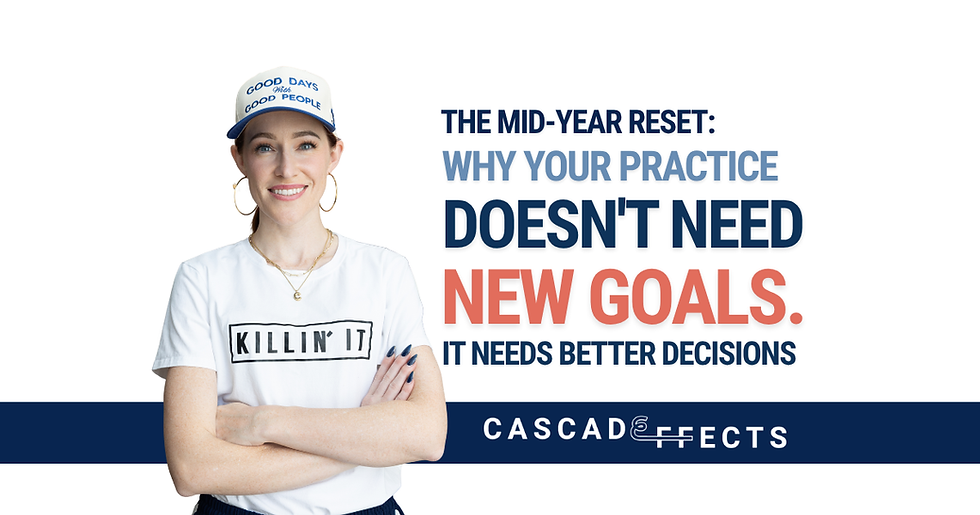
The Mid-Year Reset
January is full of optimism. You set production goals, identify strategic priorities, and leave your planning session energized about the year ahead.
Then real life happens.
A key team member leaves. Your schedule becomes harder to manage than expected. Marketing initiatives don't gain the traction you hoped for. Leadership conversations get pushed aside because there are patients to see and problems that need immediate attention. By the time July arrives, many practice owners find themselves asking the same question: How did we get so far away from the plan?
The instinct is often to create a new one. We convince ourselves that we need a fresh initiative, another piece of technology, or a completely different strategy. While those changes may eventually make sense, they're rarely the place to start.
More often than not, your goals are still the right goals. What's changed is the quality and consistency of the decisions being made every day to support them.
The middle of the year isn't an opportunity to reinvent your practice. It's an opportunity to pause, evaluate what's actually happening, and make more intentional decisions for the months ahead.
Before You Change the Plan, Evaluate the Path
One of the biggest mistakes leadership teams make is assuming that being behind means the strategy has failed. In reality, most practices don't drift off course because they lacked vision. They drift because the demands of daily operations slowly replace intentional leadership. Priorities become reactive. Projects stall. Managers spend more time solving today's problems than preparing for tomorrow's opportunities.
The result isn't dramatic. It's gradual. Weekly leadership meetings become status updates instead of strategic conversations. Improvement projects lose momentum because no one has the time to move them forward. Small operational workarounds become permanent processes simply because they're familiar.
None of those decisions seem significant on their own, but together they shape the direction of the practice. That's why a mid-year review shouldn't begin with new goals. It should begin with understanding how your organization has been making decisions over the past six months.
Look for the Decisions That Created Progress
It's easy to focus on what's missing. Strong leaders also take time to understand what's working.
Think back over the first half of the year. Which changes actually improved the way your practice operates? Perhaps your morning huddles became more focused. Maybe scheduling became more predictable after adjusting provider templates. Maybe your leadership team started resolving issues independently instead of waiting for the doctor to make every decision. These wins matter because they reveal something larger than a successful project. They show
where your systems are becoming stronger. Rather than moving on to the next initiative, ask why those improvements worked.
Was ownership clearly defined?
Did the team receive consistent coaching?
Was progress measured regularly?
Understanding the conditions that created success allows you to repeat them elsewhere in the
practice.Too often, organizations celebrate results without identifying the behaviors and structures that produced them.
Identify Where Friction Has Become Normal
Every practice develops friction points over time. The challenge is that they rarely announce themselves. Instead, they become part of the routine. Perhaps patients are waiting longer than they should because the schedule has become increasingly difficult to balance. Maybe leadership spends hours every week answering questions that should already have established processes. Or perhaps projects continue getting postponed because every urgent issue feels more important than long-term improvement.
These aren't isolated problems. They're signals that your operational structure needs attention.
One of the most valuable exercises a leadership team can complete in July is identifying the moments that consistently create frustration.
Ask questions like:
Where do we lose the most time each week?
Which decisions repeatedly come back to the doctor?
What process creates confusion for both team members and patients?
What issue have we accepted as "just the way it is"?
Those conversations often uncover opportunities that create a greater impact than launching an entirely new initiative.
Growth Often Requires Elimination Before Addition
Practice owners are natural problem solvers. When something isn't working, the instinct is to add another solution.
Another software platform.
Another report.
Another meeting.
Another position.
Another project.
Sometimes those additions are necessary. More often, they increase complexity without addressing the underlying issue. Every new responsibility competes for your team's attention. Every additional system requires training, maintenance, and accountability. Before introducing something new, it's worth asking whether there's something you can simplify or eliminate first.
High-performing practices don't grow because they continually add more work. They grow because they become increasingly disciplined about what deserves their attention.
Simplifying a workflow can create more capacity than hiring another employee. Clarifying ownership can improve execution faster than adding another meeting. Removing unnecessary complexity often gives teams the space they need to perform at a higher level.
Replace Assumptions With Visibility
Strong decisions require accurate information. That sounds obvious, yet many leadership teams spend more time reacting to anecdotes than reviewing meaningful operational data. One difficult patient interaction can overshadow an otherwise excellent week. A slow Tuesday can make it feel like new patient flow has disappeared. Without consistent visibility, it's easy for emotion to influence decision-making.
A productive mid-year review looks beyond isolated experiences and examines the trends that truly matter.
How has production compared to expectations?
Is new patient volume supporting future growth?
Where are scheduling constraints limiting capacity?
Which initiatives have made measurable progress, and which have quietly stalled?
The purpose isn't to create more reports. It's to create a shared understanding of where the practice stands today so leadership can make thoughtful decisions about tomorrow. When everyone is working from the same information, conversations become more productive and priorities become much easier to establish.
A Strong Second Half Starts With Better Leadership
The practices that finish the year strong aren't always the ones that had the best first six months. They're the ones willing to step back, evaluate honestly, and make intentional adjustments before small issues become significant obstacles.
That requires more than reviewing numbers. It requires creating the space for leadership conversations that rarely happen during a busy clinical day.
As a fractional COO, this is one of the most valuable roles CascadEffects provides. We bring an outside perspective to help practices evaluate what's working, identify where momentum has slowed, and create practical strategies that support sustainable growth. Instead of reacting to every challenge, we help leadership teams focus on the decisions that will have the greatest long-term impact.
The goal isn't simply to finish the year with stronger results. It's to build a practice that becomes easier to lead because the right systems, priorities, and leadership habits are in place.
Your January Goals May Still Be the Right Ones
Its July, you now have six months of real experience. You know which initiatives gained traction, where your team excels, and which operational challenges continue to consume valuable time and energy.
Use that information wisely. Rather than chasing new ideas, refine the way your practice makes decisions. Strengthen the systems that support your team. Simplify where complexity has crept in. Protect the priorities that matter most.
The second half of the year doesn't require a completely different vision. It requires leadership that is willing to pause, evaluate objectively, and move forward with greater clarity.
At CascadEffects, we believe sustainable growth comes from thoughtful leadership, practical systems, and intentional execution. If your practice is ready to make the second half of the year more focused than the first, let's design a strategy that helps your team move forward with confidence.
Author: Casey Bull| casey@cascadeffects.com About CascadEffects
CascadEffects is an orthodontic consulting firm that partners with growth-minded practices through a six-month embedded engagement model. Founded by Casey Bull, a former COO and Global Director with over a decade of orthodontic leadership experience and an MBA from Pepperdine University, CascadEffects is powered by a leadership team that has operated at every level of practice management.
Director of Operations Heather Broughton brings years of hands-on orthodontic operations experience, having managed multi-location practices from the inside, overseeing teams, systems, and day-to-day execution before stepping into a consulting role.
Together, Casey and Heather work shoulder to shoulder with practice teams to install leadership infrastructure, accountability systems, and team culture frameworks that drive measurable production growth, with clients achieving 20–150% growth.
CascadEffects also publishes The Cascade Report, an industry publication for orthodontic professionals.
Learn more at cascadeffects.com



Comments